Moving Minds
News & Insights
for subscribing
to Moving Minds
News & Insights
for submitting
your credentials
match a client opportunity.


JP Morgan Healthcare
Conference 2026: A Complete
Guide to JPM Week,
Takeaways, and What It Signals
for Healthcare Investors
The J.P. Morgan Healthcare Conference is the closest thing the life sciences industry has to a Super Bowl. For four days every January, roughly 9,500 people compress into a six-block radius around Union Square in San Francisco, and the rest of the year’s healthcare deal flow, fundraising, and narrative gets set in motion.
If you run a healthcare or life sciences company — especially a PE-backed one — what happens that week in San Francisco shapes how investors will price your category for the next twelve months. This is the field guide.
What Is the J.P. Morgan Healthcare Conference?
The J.P. Morgan Healthcare Conference is the largest and most influential healthcare investment symposium in the world. It is hosted annually by JPMorgan Chase & Co. at The Westin St. Francis Hotel in San Francisco, and it has been held every January at the same hotel for more than four decades. The conference itself is invitation-only — registration is restricted to clients of the firm — but its gravitational pull has built an entire surrounding ecosystem of satellite events, partnering forums, and offsite meetings that collectively go by the shorthand “JPM Week.”
For Big Pharma, the conference is a venue to set guidance and tell the year’s story. For biotech and medtech, it is a stage to announce pipeline progress, license deals, IPOs, and acquisitions. For investors, it is a four-day window into where capital is going to flow. For everyone else — service providers, advisors, recruiters, journalists — it is the single most concentrated networking event of the year.
2026 J.P. Morgan Healthcare Conference: Dates, Venue, and Key Facts
The 44th Annual J.P. Morgan Healthcare Conference (JPM 2026) was held January 12–15, 2026 at The Westin St. Francis Hotel, 335 Powell Street, San Francisco, CA 94102. Key facts:
- Dates: Monday, January 12 through Thursday, January 15, 2026
- Venue: The Westin St. Francis Hotel, Union Square, San Francisco
- Attendance: Approximately 9,500 people in San Francisco for the week, with roughly 8,000 official delegates inside the Westin
- Format: Invitation-only company presentations, fireside chats, one-on-one investor meetings, and concurrent satellite events
- Economic impact: “$105 to $110 million for our local economy,” per Alex Bastian of the San Francisco Hotel Council, quoted by ABC7 San Francisco
- Hotel rates: Standard rooms in Union Square averaged more than $1,500 per night during the week
- Organizer: JPMorgan Chase & Co.
- Next year: JPM 2027 is scheduled for January 11–14, 2027 at the same venue

A Brief History: From 20 Companies in 1983 to ~9,500 Attendees Today
The conference began in 1983 as the H&Q Healthcare Conference, hosted by Hambrecht & Quist, a boutique San Francisco investment bank founded in 1968 by William Hambrecht and George Quist. The first event featured roughly 20 companies presenting to about 200 attendees, with a tight focus on the emerging biotech sector that H&Q had built its franchise around.
On December 10, 1999, The Chase Manhattan Corporation completed its $1.35 billion acquisition of Hambrecht & Quist Group. Shortly after, J.P. Morgan and Chase combined, and the conference took the J.P. Morgan name it carries today. The venue never moved. Four decades later, the same Westin St. Francis lobby that hosted a few hundred biotech executives in the mid-1980s now strains under the weight of roughly 9,500 conference-goers, plus the thousands more conducting business across the Hilton, the Marriott Marquis, the InterContinental, and every coffee shop within walking distance.
Who Attends? Inside JPM’s Invitation-Only Guest List
The official conference is for clients of J.P. Morgan, by invitation only. The published agenda for JPM 2026 included sessions across pharmaceutical, biotech, medical device, diagnostics, healthcare services, and not-for-profit categories, with private-company and APAC sessions running in parallel.
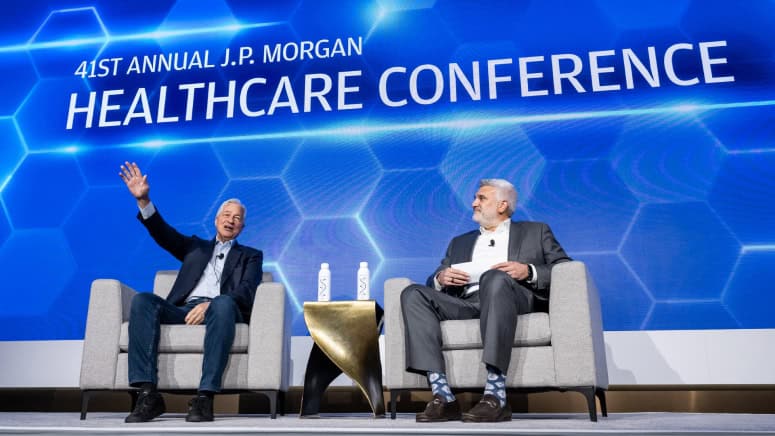
Inside the Westin
- C-suite executives from publicly traded pharma, biotech, medtech, diagnostics, and healthcare services companies
- CEOs and CFOs of private companies presenting in the private-company track
- Institutional investors, hedge funds, crossover funds, and sovereign wealth funds
- Venture capital and private equity general partners
- Sell-side analysts and senior bankers
- Senior government and regulatory officials
Working the surrounding ecosystem
- Early-stage biotech and medtech founders meeting with investors at Biotech Showcase, RESI, and BIO Partnering
- Service providers — CDMOs, CROs, law firms, IR firms, communications agencies, fractional CMOs — working the lobbies and offsite venues
- Trade-association delegations, including MassBio, Biocom California, and dozens of state and country pavilions
- Journalists from STAT, Fierce Biotech, Endpoints News, BioPharma Dive, MM+M, Bloomberg, and the Wall Street Journal
One notable change for 2026: the major health insurers largely sat the conference out. STAT reported in December 2025 that Centene, Cigna, CVS Health, Humana, Molina Healthcare, and Oscar Health were not on the initial 2026 agenda despite being mainstays in prior years. The reasons cited included high costs, quiet-period rules around fourth-quarter earnings, investor skepticism toward the managed-care category, and lingering safety concerns following the December 2024 killing of UnitedHealthcare CEO Brian Thompson. The result was a more biopharma- and medtech-weighted week than in recent years.
JPM Week: The Conference That’s Bigger Than the Conference
Most people who travel to San Francisco for “JPM” never set foot inside the Westin. The official conference is the gravitational center, but the actual work happens across a constellation of satellite events and private meetings spread across Union Square, SoMa, and the Financial District. The most prominent satellite events in 2026 included:
- Biotech Showcase — January 12–14, 2026 at the Hilton San Francisco Union Square. The 19th edition drew more than 3,200 global biopharma professionals and 1,200+ life sciences investors.
- RESI JPM (Redefining Early Stage Investments) — January 12–13 in-person at the San Francisco Marriott Marquis, with virtual partnering on January 14, 19, and 20.
- BIO Partnering @ JPM — One-to-one partnering meetings run by the Biotechnology Innovation Organization at the Marriott Marquis.
- StartUp Health Festival, Rock Health Summit, and digital-health-focused convenings across SoMa.
- WuXi Global Forum and a wave of China-focused investment forums, reflecting the increasing weight of China-origin licensing in biopharma dealmaking.
- State and regional pavilions — MassBio at the Omni, Biocom California at the Parc 55, Israel Healthcare Lounge at the Parc 55, and others.
- The unofficial track: invite-only dinners, lobby coffees at the Four Seasons and Le Méridien, breakfast meetings at John’s Grill, and the mobile meeting rooms — including rented buses — that some venture firms now use to dodge the lobby crush.
If this is the first January your calendar points at San Francisco, the surface area is the problem. The official conference is the part everyone names; the week around it is where the actual meetings happen, and there is no published map. First-timers routinely arrive without a plan, burn three days on the wrong rooms, and leave with a stack of business cards that never convert.
Why JPM Matters: The Super Bowl Effect on Deals and IPOs
JPM matters because it sets the year’s narrative. Big Pharma uses the conference to issue guidance, defend valuations, and signal where it intends to spend. Biotech and medtech use it to announce IPOs, licensing deals, and acquisitions timed to maximize coverage. Investors use it to calibrate which categories deserve premium multiples in the year ahead. The deals announced during JPM week — whether at the conference itself or in the run-up — frequently dictate which therapeutic categories get crowded and which get capital-starved for the next twelve months.
Per DelveInsight’s JPM Healthcare 2026 highlights recap, the conference generated approximately $8.3 billion in announced deals, with emphasis on oncology (particularly PD-1/VEGF bispecifics and antibody-drug conjugates), obesity market expansion, and neurodegenerative disease therapeutics — a figure that excludes the $14.5 billion Boston Scientific–Penumbra medtech transaction that landed on the final day. Headline deals from JPM 2026 included:
- Boston Scientific to acquire Penumbra for approximately $14.5 billion — announced Thursday, January 15, 2026 in a cash-and-stock transaction valuing Penumbra at $374 per share.
- AbbVie / RemeGen — up to $5.6 billion for ex-Greater China rights to RC148, a PD-1/VEGF bispecific antibody for advanced solid tumors. $650 million upfront plus up to $4.95 billion in milestones.
- Novartis / SciNeuro Pharmaceuticals — up to approximately $1.665 billion for a next-generation de novo amyloid beta antibody program for Alzheimer’s disease.
- Eli Lilly × NVIDIA — $1 billion Bay Area co-innovation lab for AI-driven drug discovery.
- Aktis Oncology IPO — $365.4 million gross, the first biotech IPO of 2026 and a closely watched read on the reopening IPO window.
- Parabilis Medicines — $305 million Series F to advance zolucatetide (FOG-001) into a registrational study in desmoid tumors.
- Novartis / Zonsen PepLib — $50 million upfront plus milestones for a peptide-based radioligand therapy asset.

Year-by-Year Snapshot (2023–2026)
| Year | Edition / Dates | Attendance | Headline deal(s) | Dominant theme |
|---|---|---|---|---|
| 2023 | 41st · Jan 9–12 | ~8,000 delegates; first in-person edition after the pandemic | Chiesi / Amryt ($1.48B); Ipsen / Albireo ($952M); J&J / Abiomed ($17B) | Return to in-person; Alzheimer’s and diabetes pipelines; cautious M&A reset |
| 2024 | 42nd · Jan 8–11 | ~8,000 delegates | J&J / Ambrx ($2B); Merck / Harpoon ($680M); Boston Scientific / Axonics ($3.7B); GSK / Aiolos ($1.4B) | Antibody-drug conjugates emerge as hottest category; AI-as-infrastructure narrative |
| 2025 | 43rd · Jan 13–16 | ~8,000+ delegates; 550 presenting companies | J&J / Intra-Cellular ($14.6B); Lilly / Scorpion (up to $2.5B); GSK / IDRx (up to $1.15B) | Dealmaking resurgence; obesity/GLP-1 dominates; security elevated |
| 2026 | 44th · Jan 12–15 | ~9,500 in SF; ~8,000 official delegates | Boston Scientific / Penumbra ($14.5B); AbbVie / RemeGen (up to $5.6B); Novartis / SciNeuro (up to ~$1.665B); Lilly × NVIDIA ($1B) | “Pragmatic optimism” — AI proof, oral GLP-1s, China licensing, MFN overhang |
Top Themes from the 2026 J.P. Morgan Healthcare Conference
Across the official sessions, the satellite events, and the lobby conversations, seven themes defined JPM 2026.
1. AI moves from “Promise to Proof.” Where prior conferences focused on AI’s potential, JPM 2026 emphasized measurable impact and return on investment. Investors were noticeably skeptical of generic “AI-powered drug discovery” claims and were instead asking how proprietary data assets and closed-loop wet labs are actually reducing clinical failure rates or compressing development timelines. The Eli Lilly × NVIDIA $1 billion co-innovation lab announced during the week was the most visible expression of this shift.
2. Dealmaking is back, but it is disciplined. The optimism anticipated after JPM 2025 largely materialized in the fourth quarter of 2025, but not in the form of splashy mega-mergers. Strategics and financial sponsors at JPM 2026 were pursuing smaller, targeted acquisitions, licensing arrangements, and portfolio-shaping transactions. Boston Scientific’s $14.5 billion Penumbra acquisition was the headline exception.
3. Obesity 2.0 — oral, durable, muscle-sparing. For three consecutive conferences, GLP-1 agonists from Novo Nordisk and Eli Lilly had sucked the oxygen out of the room. In 2026 the conversation matured beyond injectable Wegovy and Zepbound clones. Investor attention shifted to oral small-molecule formulations, muscle-preservation combinations, and maintenance regimens. Pfizer CEO Albert Bourla reiterated his hyper-bullish view of the revenue potential for obesity drugs, stating he expects them to record some $150 billion in yearly sales by 2030.
4. China-origin licensing accelerates. AbbVie’s $5.6 billion deal with RemeGen for RC148 and Novartis’s roughly $1.665 billion SciNeuro deal were the most visible markers of a trend now backed by hard data. In 2025, licensing agreements involving US biopharmaceutical companies in-licensing an innovative drug from China reached almost 50%. Faster patient enrollment, condensed development timelines, and a deep bench of differentiated assets have made China-based biotechs a primary hunting ground for U.S. and European Big Pharma.
5. Radiopharmaceuticals, ADCs, and multispecifics dominate oncology. Aktis Oncology’s $365 million IPO, the Novartis / PepLib radioligand deal, and a steady flow of ADC and bispecific licensing transactions cemented these three modalities as the consensus oncology modalities of 2026. Precision oncology with proven biomarker strategies continued to attract premium valuations.
6. Women’s health and longevity graduate from niches. Women’s health is no longer a niche — buzzing with significant exits over the prior year, strong current growth, and increasing appreciation of the untapped potential in menopause, maternal health, and AI-powered diagnostics. Longevity moved from a wellness conversation to a credible therapeutic category, with aging increasingly framed as a manageable biological process.
7. Most-Favored-Nation pricing becomes the new policy overhang. The Trump administration’s announcement of the “Great Healthcare Plan” on the final day of JPM 2026 — calling on Congress to codify MFN drug pricing in statute — heightened concerns that had been building through 2025. Tariff threats appeared to have already done some of their work: multiple CDMOs announced new U.S. manufacturing capacity during the conference.
What This Means for PE-Backed Healthcare Portfolio Companies
If you run a PE-backed healthcare or life sciences business, JPM is not just a calendar event — it is a forward-looking market for the categories your sponsor needs to underwrite. Three implications matter most.
1. The categories getting capital at JPM will be the categories getting premium multiples at exit. If you operate in a category that was crowded at the Westin — oncology precision, radiopharma services, AI-enabled R&D infrastructure, oral metabolic, women’s health, longevity — your sponsor’s IC has a stronger story to tell on exit comps. If you operate in a category that was quiet — pure-play digital health point solutions, undifferentiated managed care services, generic-AI overlays — expect a longer hold and a tougher exit conversation.
2. The narrative discipline visible at JPM 2026 is now table stakes. “Pragmatic optimism,” “execution over hype,” “proof not promise” — these were the phrases every credible CEO used at JPM 2026. Portfolio companies still pitching with 2021-era growth-at-any-cost narratives will read as out of step.
3. The MFN and tariff overhang has to be addressed in your investor narrative, even if you are not directly exposed. Sponsors and LPs are now asking healthcare portfolio companies how MFN pricing, tariffs, and the “Great Healthcare Plan” affect the path to exit. Even healthcare services and tech-enabled businesses with no direct drug exposure are getting the question. A clean, defensible one-paragraph answer in your CIM is no longer optional.
Most PE-backed CEOs we work with don’t have a narrative problem. They have a translation problem — the operating story is real, but it has never been compressed into the language a JPM analyst uses at 9:14 a.m. between meetings. Fixing that is what a fractional CMO for private equity actually does.
The companies that come out of JPM week with momentum tend to share three habits: they invested in narrative architecture months before the conference, not weeks; they instrumented their marketing so that pipeline and brand searches could be correlated with conference activity; and they treated the week as a paid-media event, not a sales trip. For sponsors evaluating new platform deals, this is also why marketing due diligence has moved from a “nice-to-have” line item into a standard workstream, and why operating partners increasingly own CMO-level growth strategy across the portfolio.
“The companies that get a second meeting out of JPM aren’t the ones with the deepest pipeline. They’re the ones whose story sticks after the analyst has heard 29 other pitches that day.”

We’ve watched well-funded biotechs walk out of the Westin with nothing because the deck read like a science seminar and the CEO never named the category. The mistakes are predictable. Five of them account for most of it.\
How to Participate Without an Invitation
You cannot register for the official J.P. Morgan Healthcare Conference unless you are a client of J.P. Morgan or have been extended a non-transferable invitation. But the actual work of JPM week happens outside the Westin, and the surrounding ecosystem is largely accessible if you plan early. Six practical steps:
1. Book a hotel by August. Union Square rates routinely exceed $1,500 per night during JPM week, and the closest properties to the Westin sell out months in advance. The Hilton Union Square, the Marriott Marquis (RESI host hotel), the Parc 55, and the InterContinental are the highest-utility addresses.
2. Register for a satellite event. Biotech Showcase, RESI JPM, and BIO Partnering @ JPM are paid events that put you inside the partnering ecosystem with one-on-one meeting tools. These are where the real first meetings happen for early-stage and mid-stage companies that are not on the official Westin track.
3. Build a meeting plan, not an event plan. First-timers default to attending sessions. Operators default to scheduling meetings. Block your calendar in 30-minute increments before you arrive, with a coffee location anchored to each block. Lobby ambushes are real but unreliable; calendared coffee at a specific table at the Le Méridien lobby is better than five hours of hopeful wandering at the Westin.
4. Use the trade-association lounges as offices. MassBio, Biocom California, and similar state and country pavilions provide free or member-only meeting space in walking distance of the Westin. If you do not have a hotel suite, these are your second-best base of operations.
5. Time your news for Monday or Tuesday. Trade press attention compresses around the conference’s first two days. Announcements published Thursday afternoon or Friday get a fraction of the coverage of the same release published Monday morning at 6:00 a.m. ET.
6. Plan the follow-up before the week starts. The companies that convert JPM contacts are the ones with a follow-up sequence written before they fly in. Email cadences, calendar links, and a clean one-page leave-behind in PDF form should be ready by January 5, not improvised on the flight home.
Frequently Asked Questions
What are the dates of the J.P. Morgan Healthcare Conference 2026?
The 44th Annual J.P. Morgan Healthcare Conference was held January 12–15, 2026 at The Westin St. Francis in San Francisco. The 45th edition (JPM 2027) is scheduled for January 11–14, 2027 at the same venue.
Where is the conference held?
The conference has been held at The Westin St. Francis Hotel, 335 Powell Street, San Francisco, CA 94102, since its founding in 1983 as the H&Q Healthcare Conference. Most satellite events are within a six-block radius of Union Square.
Who can attend the J.P. Morgan Healthcare Conference?
Attendance at the official conference is by invitation only and restricted to clients of J.P. Morgan. Invitations are not transferable. JPMorgan’s own conference page states: “Registration of J.P. Morgan Healthcare Conference is for clients of the firm, by invitation only. Please reach out to your J.P. Morgan representative to inquire about an invitation.”
How do I get an invitation?
The only formal route is through an existing J.P. Morgan banking relationship. Companies preparing for an IPO, sell-side process, or strategic transaction often receive invitations through that relationship. For everyone else, the practical path is to attend the surrounding JPM Week events — Biotech Showcase, RESI, BIO Partnering — and meet investors and bankers in the surrounding ecosystem.
How many people attend?
Approximately 8,000 official delegates attend the conference itself, and roughly 9,500 people are in San Francisco during the week when satellite events are included. ABC7 News reported the 9,500 figure for JPM 2026; San Francisco Standard and other outlets reported “around 8,000” for the official conference.
What is JPM Week?
“JPM Week” is the umbrella term for the official J.P. Morgan Healthcare Conference plus the dozens of concurrent satellite events, partnering forums, investor meetings, receptions, and unofficial gatherings that take place across San Francisco the same week.
What does it cost to attend JPM Week?
For attendees of the official conference, there is no published registration fee — invitations are extended through J.P. Morgan. For attendees of satellite events, registration fees vary: Biotech Showcase ran roughly $2,000–$3,000 for standard delegate access; RESI JPM offered Premier and Exhibitor packages from approximately $600 up to $6,790. The bigger cost is hotels: Union Square rates averaged more than $1,500 per night during JPM 2026.
What were the biggest deals announced at JPM 2026?
The largest transaction was Boston Scientific’s agreement to acquire Penumbra for approximately $14.5 billion, announced January 15, 2026. Other major announcements included AbbVie’s up-to-$5.6 billion licensing deal with RemeGen for RC148, Novartis’s up-to-$1.665 billion SciNeuro Alzheimer’s licensing deal, the Eli Lilly × NVIDIA $1 billion AI co-innovation lab, Aktis Oncology’s $365 million IPO, and Parabilis Medicines’ $305 million Series F.
What were the major themes at JPM 2026?
The dominant themes were AI moving from promise to proof, a more disciplined dealmaking environment, the maturation of the obesity/GLP-1 conversation into “Obesity 2.0,” accelerating China-origin licensing, the entrenchment of radiopharmaceuticals/ADCs/multispecifics as oncology’s lead modalities, the mainstreaming of women’s health and longevity as investable categories, and the rising overhang of Most-Favored-Nation drug pricing.
Why are major insurers skipping JPM 2026?
STAT reported in December 2025 that Centene, Cigna, CVS Health, Humana, Molina Healthcare, and Oscar Health were not on the initial 2026 agenda. Reasons cited included the high cost of attending, fourth-quarter quiet-period rules, investor skepticism of the managed-care category, and lingering security concerns following the December 2024 killing of UnitedHealthcare CEO Brian Thompson.
What is Biotech Showcase and how is it different from JPM?
Biotech Showcase is a paid, registration-open partnering event held concurrent to JPM at the Hilton San Francisco Union Square. Now in its 19th year, it is co-produced by Demy-Colton and EBD Group (Informa) and drew more than 3,200 global biopharma professionals and 1,200+ investors in 2026. Unlike JPM itself, anyone can register, and the partneringONE platform schedules one-on-one meetings between presenting companies and investors.
How can a PE-backed healthcare company use JPM Week effectively?
Treat JPM as a paid-media event with a 12-month return horizon, not a transactional sales trip. The highest-ROI uses are: refining the company narrative against live investor reactions, gathering competitive intelligence on adjacent categories, securing introductions to crossover funds and strategic acquirers, and timing announcements for Monday/Tuesday coverage.
When is the next J.P. Morgan Healthcare Conference?
The 45th Annual J.P. Morgan Healthcare Conference (JPM 2027) is scheduled for January 11–14, 2027 at The Westin St. Francis in San Francisco. The conference has been held in the second or third week of January, at the same hotel, every year since 1983.
The Bottom Line: Why JPM Still Matters in 2026
JPM has been pronounced over more times than any conference in any industry. The lines are too long, the hotels are too expensive, the streets are too crowded, the weather is unreliable, and the official conference is closed to most of the people who matter. None of that has dented its gravitational pull, because the alternative — a year of trying to manufacture the same density of meetings, capital, and narrative-setting — does not exist. JPM 2026 confirmed what JPM 2023, 2024, and 2025 already suggested: the conference itself is increasingly a backdrop, but the week around it is the single most important market-making event in healthcare and life sciences.
For PE-backed healthcare CEOs and their sponsors, the practical question is not whether to be there. It is whether your narrative, your team, and your operating story are ready for the room. That is the work we do at Moving Minds for private equity, through our fractional CMO practice, and as an outside operating partner for sponsors who want their portfolio walking into San Francisco with something to say.
Consult



News & Insights
Ready to put your
marketing on autopilot?
Schedule a consult to explore how we can support your growth priorities — from strategy through seamless execution — as your dedicated marketing partner or an extension of your in-house team.





GROWTH AS A MANAGED SERVICE™
awareness, demand and
shareholder value for our
client companies.